PoemMetaVis

Poetry metadata visualization and exploration

PoemMetaVis is a novel, powerful, and user-friendly visualization tool for interactive exploration of hidden associations among annotated poetry metadata and their pattern changes in both time and location dimensions.

The integration of interconnected components allows efficient search, cross-filter, and simultaneous investigation of multiple aspects of the dataset at various levels of granularity without programming efforts.

With rich metadata, PoemMetaVis can aid in better understanding complex dynamics in works of poetry that are otherwise invisible using traditional close reading approaches.
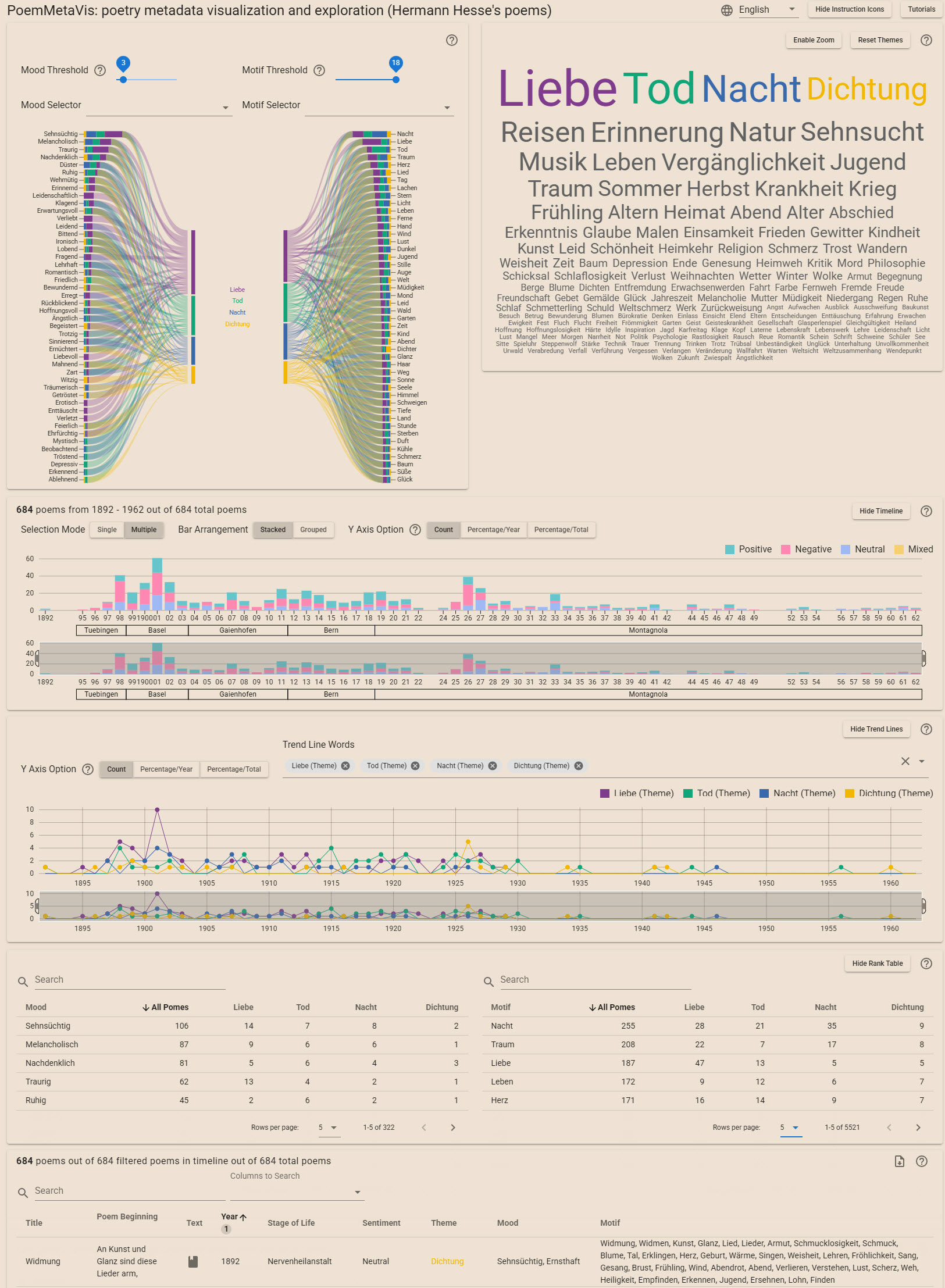
PoemMetaVis — full interface overview
Fig. i · full interface overview

PoemMetaVis Demo Video

PoemMetaVis DemoWalkthrough

Frequently asked questions

What is PoemMetaVis?

PoemMetaVis is a web-based interactive visualization tool for exploring annotated poetry metadata — moods, themes, motifs, sentiments — across time and location.

Who is it for?

Literary scholars, digital-humanities researchers, students, and anyone curious about reading patterns that close reading alone cannot reveal.

Do I need to install anything?

No. The tool runs entirely in the browser. Just open one of the case studies and start exploring.

Which datasets are currently available?

Two: Hermann Hesse (684 German-language poems, fully annotated) and Su Dongpo (a collection of Chinese song ci lyrics).

Can I use my own data?

Yes — the visualization is language-agnostic. Get in touch if you would like to apply it to a new poetry corpus.

Collaboration

PoemMetaVis is language-agnostic and built to grow. We welcome partnerships with literary scholars, digital-humanities labs, archives, and publishers who would like to apply the tool to a new poetry corpus.

Concretely, we are open to:

If any of these resonate, please reach out via the Contact section below.

Contact

Project leader & contact Wei Ding
Johannes Gutenberg University Mainz Mainz, Germany
University of Basel Basel, Switzerland

We would like to thank Gerhard Lauer, Lingping Ma, Xin Wang, Julia Kammerzelt, and Helen Hunter for their stimulating discussions and contributions.